
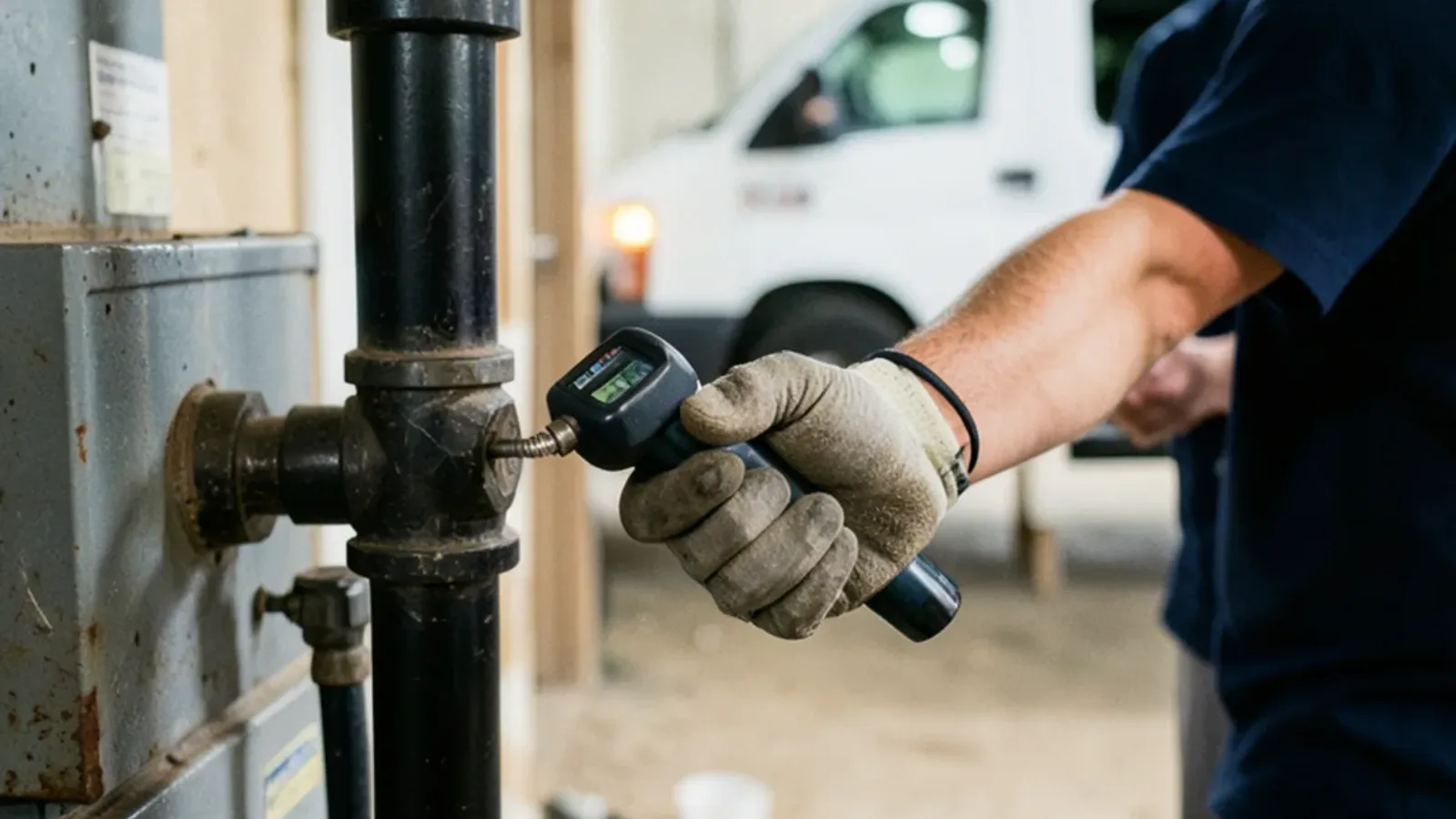
If you smell gas in a Warren home, leave the building now. Don't flip light switches, unplug anything, use the garage door opener or strike a match or lighter on the way out, and don't use your phone until you're outside. Skip looking for the leak or closing valves. From outside, call 911 or Consumers Energy, which supplies natural gas in Warren, and stay out until Consumers says it's safe.
Gas leak detection and repair in the house comes after that. The utility's first job is to make the situation safe, which can mean shutting off gas at the meter and tagging an appliance. Finding the leaking joint in your house piping, repairing it, and proving the system tight is regulated work in Michigan. Here's what it involves and who is allowed to do it.
What counts as a gas leak emergency?
Natural gas has no smell of its own. Utilities add an odorant that smells like rotten eggs so a leak is hard to miss. Treat any of these as an emergency and follow the steps above.
| Sign | Where you might notice it | What to do |
|---|---|---|
| A rotten-egg smell that stays | Near the furnace, water heater, range, dryer or gas meter | Leave and call from outside |
| Hissing or whistling from a pipe or appliance | At a connector, valve or the meter | Leave and call from outside |
| Dead or discolored grass in a line across the yard | Over the buried service line to the meter | Keep people away and call the utility |
| Bubbles rising in a puddle or wet ground | Along the service line route | Keep people away and call the utility |
| A carbon monoxide alarm sounding | Anywhere in the house | Get everyone into fresh air and call 911 |
A faint whiff for a second when a range burner lights is common. A smell that hangs in the room, or keeps coming back near one appliance, is not. When you can't tell, act as if it's a leak. A call that turns out to be nothing costs you an hour. Waiting on a real leak can cost far more.
What happens after you call Consumers Energy or 911
A responder checks the air with a gas detector, inside and out. If they find a leak on the utility's side of the meter, the utility handles it. If the leak is in the house piping or an appliance, they may shut the gas off at the meter, or close and tag one appliance so it can't be used. Everything downstream of the meter is the homeowner's to repair. Before the gas goes back on, the leak has to be fixed and the house piping shown to hold pressure, and the utility decides when to restore service.
That's usually when the repair becomes urgent, because the furnace and water heater are cold. Keep any tag or notice the responder left; it tells whoever does the repair what was found.
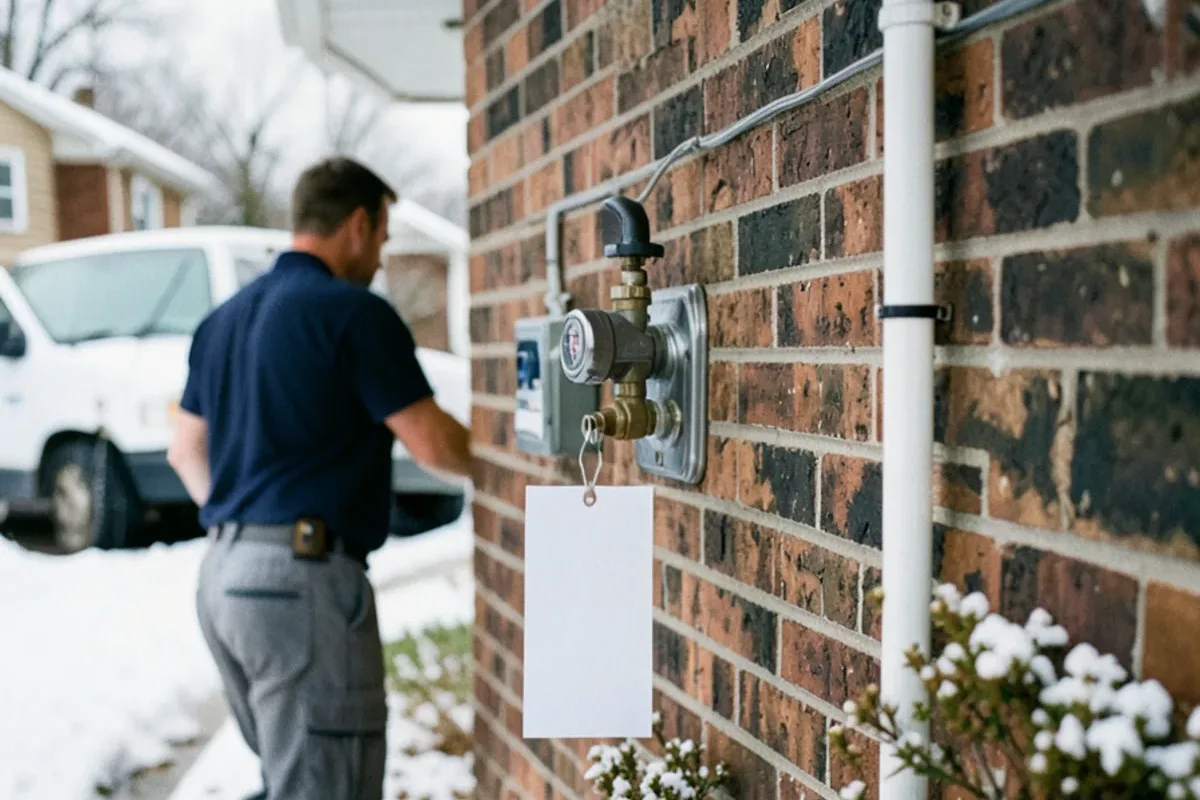
What a gas leak repair covers once the air is clear
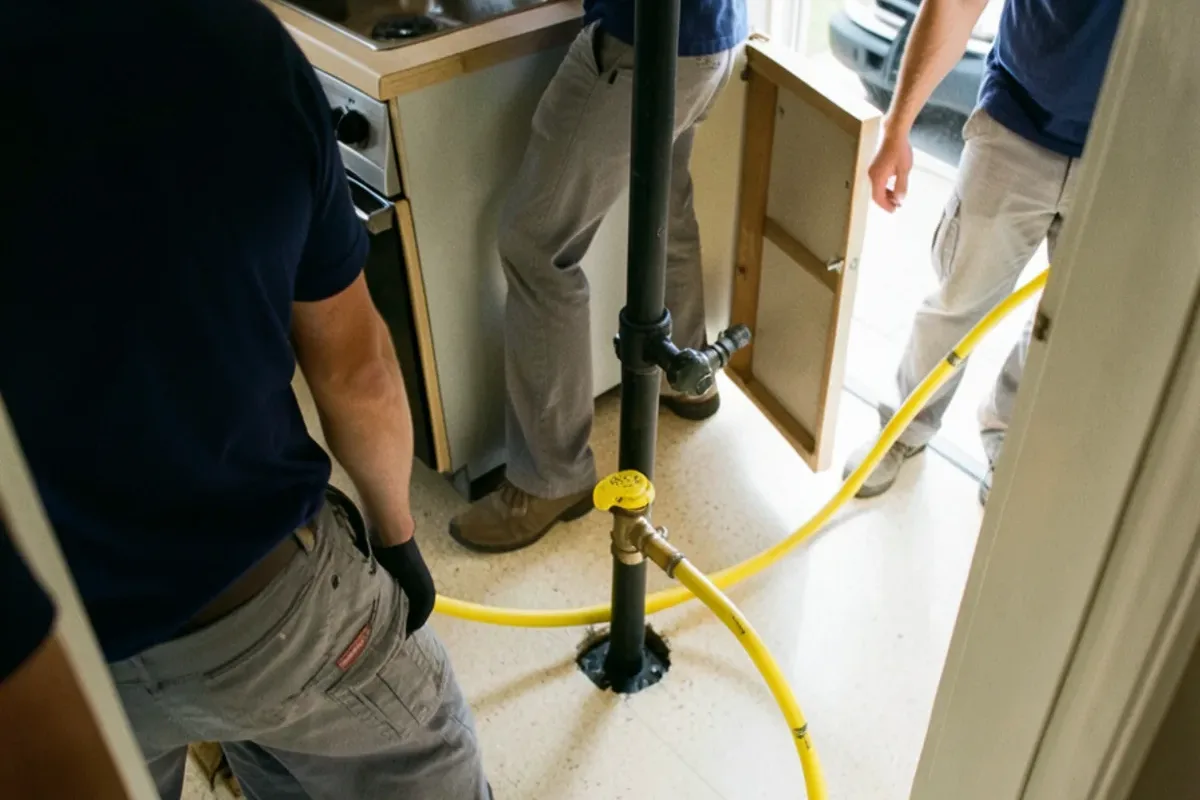
The repair starts after the utility has checked the air and shut off the meter or tagged an appliance. The goal is to find every leak on the house side, not only the one that caused the smell, fix each one with parts rated for gas, and prove the piping tight before service is restored. In a Warren house that has had two or three furnaces and water heaters since the 1960s, that means a lot of joints. The scope usually covers:
- Confirming from the responder’s tag what was shut off
- Testing the whole house system, not only the suspect appliance
- Remaking joints, replacing connectors and valves, or cutting out rusted black iron
- The mechanical permit and inspection when the scope calls for them
Start from the utility’s notice
The tag says what the responder found and what was closed.
Pressure test the system
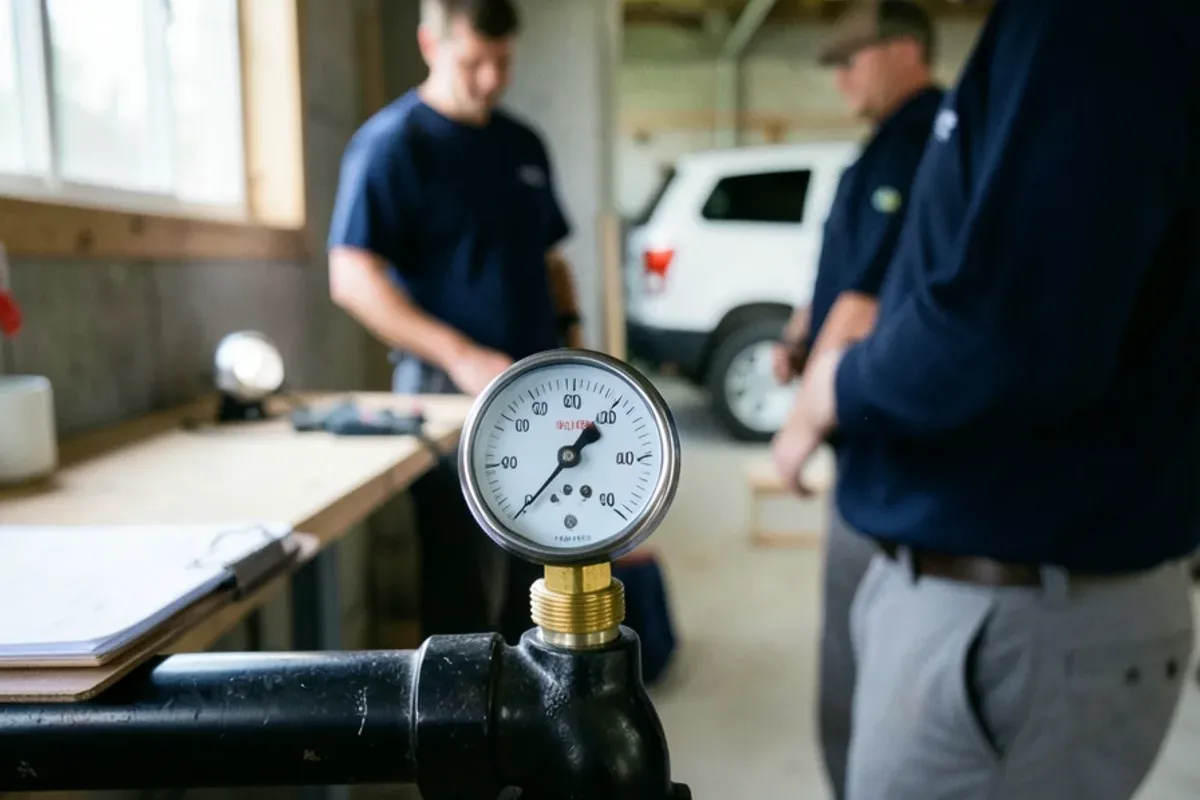
The piping is isolated and a gauge shows whether pressure drops over the test period.
Find each leak
A detector along the run, then bubble solution on suspect joints. Never a flame.
Repair with gas-rated parts
Joints remade, connectors and valves replaced, rusted pipe cut out.
Retest the whole run
The same test again, and the gauge has to hold.
Restore and relight
The utility decides when gas returns; each appliance is then relit and its flame checked.
How gas leak detection inside a house works
A pressure test of the whole system
The surest way to know whether house piping leaks is to isolate it, put a gauge on it and see whether the pressure drops over a set period. A drop means a leak somewhere, even one too small to smell. The same test is repeated after the repair to prove the fix held.
Narrowing it down joint by joint
An electronic combustible gas detector is moved slowly along the run, pausing at every fitting, valve and connector. Suspect joints are then checked with a leak-detection solution that bubbles where gas escapes. Never a flame. In Warren basements the usual leak points are:
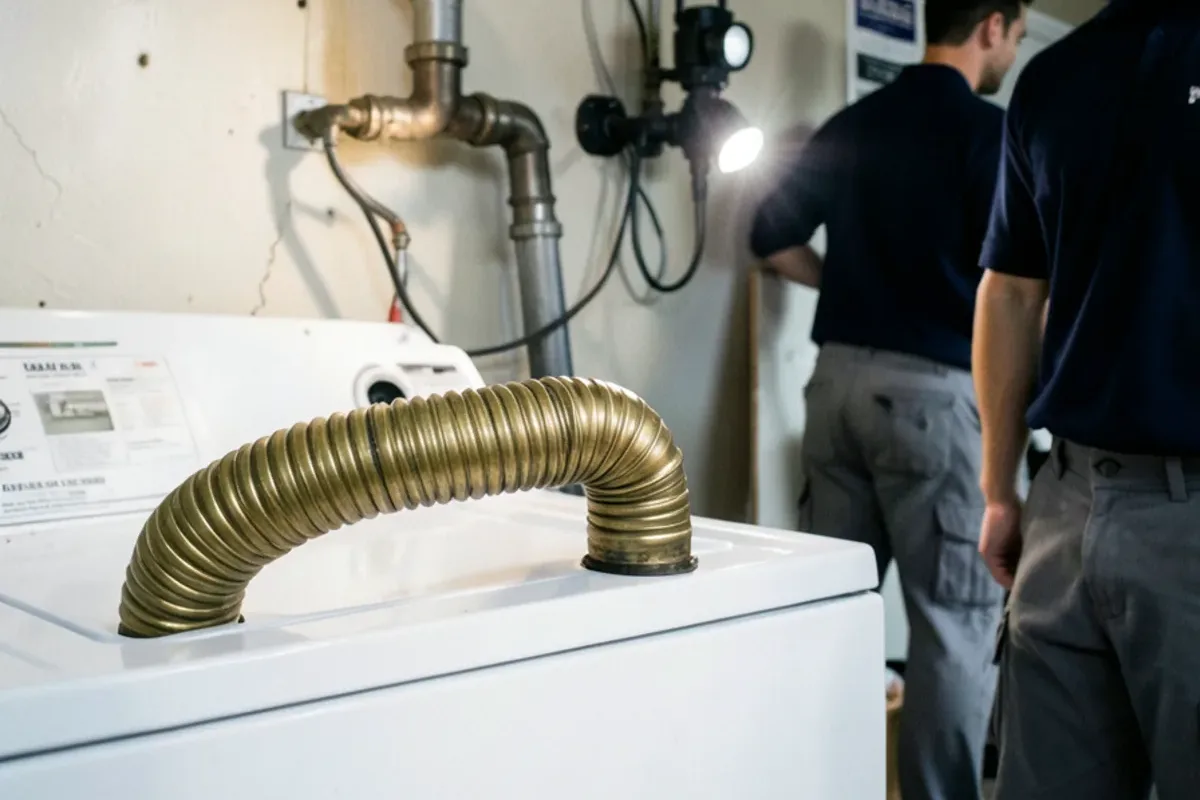
- Flexible appliance connectors, especially older uncoated brass ones behind ranges and dryers.
- Flare nuts and unions at the furnace and water heater, which get bumped and loosened over the years.
- The stem packing on old appliance shutoff valves.
- Threaded black iron joints where the pipe comes through the rim joist from the meter, where moisture causes rust.
- Dryer connectors kinked or crushed when the dryer was pushed back against the wall.
Age ties these together in Warren. About 74 percent of the city's homes were built between 1950 and 1979, so most house gas piping has been in place for decades and has seen several furnace, water heater, dryer and range swaps. Each swap is a chance for a reused connector or a joint that was disturbed and never retested.
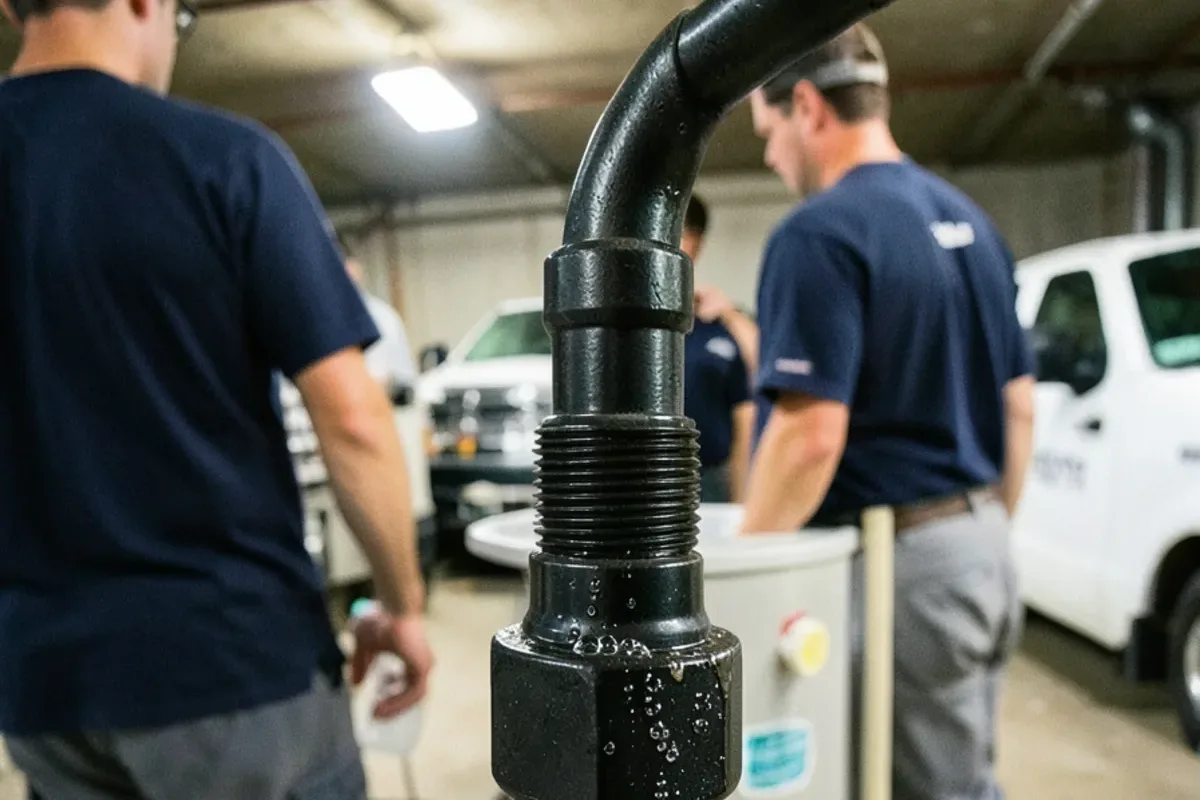
Gas leak repair in Warren, from the fix to the retest
Most repairs are small once the leak is found: a joint taken apart and remade with sealant rated for gas, a connector and shutoff valve replaced, or a rusted section of pipe cut out and replaced.
Mechanical permits and licensing for gas work
What makes it different from plumbing is the rule set around it. Michigan licenses fuel gas piping under mechanical classifications. State rules define a fuel gas piping license, for piping from the point of delivery to each appliance shutoff valve, and a fuel gas piping and venting license; an HVAC equipment license holder doesn't need either one. In Warren, residential gas piping is on the mechanical permit form, not the plumbing form, and that permit comes from the city's Division of Buildings and Safety Engineering at One City Square.
So before anyone works on your gas piping, ask what mechanical license they hold and check it on LARA's license search. A plumbing license alone shouldn't be assumed to cover gas work. After the repair, the piping is pressure tested again, the utility restores service, and each appliance is relit and checked for a steady, blue flame.
Can you stay in the house while the gas is off?
Usually, once the utility says the air is clear. You'll be without the furnace, the water heater and a gas range until the repair is made and service is restored. In January that's a frozen pipe risk, so use electric space heaters with care, open cabinet doors on outside walls, and let a faucet drip. Our page on frozen pipe repair has more on keeping lines from freezing. Never use a gas oven or a grill indoors for heat.
What shapes the cost of a gas leak repair
- How many leaks the pressure test finds. A single loose union is a small job; an old system can have several.
- Where the leak is. Exposed basement pipe is easy to reach. Pipe inside a finished wall or under a floor is not.
- What gets replaced: a connector and valve, a section of black iron, or a longer run.
- Whether the permit and inspection that apply in Warren are needed for the scope of the repair.
Nobody can price a gas repair from a phone call, because nobody knows yet how many leaks the test will turn up. One loose union at the water heater and an old system leaking at several joints are different days of work. You hear which factors apply, and see the scope in writing, before the repair starts.
Gas calls in Warren, starting where the utility left off
Our office is at 11355 Stephens Rd in 48089, the part of Warren with the oldest houses. Homeowners, landlords with a tenant's tagged furnace and business owners all reach us on one phone line. On a gas call we start from the responder's notice, explain what the pressure test and repair involve, and go over what moves the cost before anything is scheduled. You get the scope in writing, along with which mechanical permit Warren requires for it and who is allowed to do the work.
Keeping gas piping tight after the repair
Replace the connector whenever you replace a range or dryer; reusing an old one is how many leaks start. Leave room behind the dryer so its connector isn't crushed. Put a carbon monoxide alarm on every level, including the basement. If you're adding a gas appliance, have the line sized for it instead of tapping into whatever pipe is closest; gas line installation and repair explains how that's planned. Knowing how to shut off gas to an appliance helps when one is being serviced, but if you smell gas, don't stay to close valves. Leave.
Gas leak detection and repair around Warren and nearby cities
- Plumber in Sterling Heights
Also on Consumers Energy, with gas heat in about 89 percent of homes and furnaces in 1970s basements.
- Plumber in Roseville
About 87 percent of homes heat with gas, mostly 1950s and 1960s houses on their original piping.
- Plumber in Eastpointe
Gas heats 89 percent of homes, many of them older bungalows with one cramped basement gas run.
- Plumber in Fraser
Gas heat in 91 percent of homes, and condo meters and water heaters often share a mechanical room.
- Plumber in Royal Oak
Gas heats 83 percent of homes, and 61 percent predate 1960, so original black iron is common.
- Plumber in Grosse Pointe Woods
The June 2021 storm damaged many basement water heaters; flooded gas controls need checking before use.
- Plumber in Center Line
About 13 percent of units are in 50-plus unit buildings, where one gas smell affects many households.
- Plumber in Hazel Park
Small Cape Cod utility spaces crowd the dryer against the wall, where its connector gets crushed.
- Plumber in Madison Heights
Forty percent of homes are 1950s builds, with threaded black iron rusting where it meets the rim joist.
Gas leak detection and repair questions from Warren customers
Should I call a plumber for a gas leak?
No, not first. If you smell gas, leave and call 911 or Consumers Energy from outside. The utility makes it safe. After that, the leak in your house piping is repaired by someone holding the right Michigan mechanical license for fuel gas work, and Warren treats gas piping as mechanical work with its own permit.
Who is responsible for fixing a gas leak, the utility or me?
The utility owns and repairs the service line and the meter. Piping on the house side of the meter, plus the appliances and their connectors, belongs to the property owner. The responder will tell you which side the leak is on, and the gas stays off until your side is repaired and tested.
Can I check for a gas leak with soapy water myself?
No, not if you smell gas. Consumers Energy's guidance is to leave without looking for the leak. Bubble solution is one of the tools used after the utility has made the house safe, together with an electronic detector and a pressure test of the whole system.
Is a gas smell near the water heater an emergency?
Yes, treat it as one. Leave the house and call from outside. Water heaters have a union, a shutoff valve and a gas control valve close together, and any of them can leak. Once the utility clears the house, our water heater repair page covers what to check on the heater itself.
Is a small gas leak dangerous?
Yes. A leak you can smell means gas is collecting somewhere, and a spark from a switch, a phone or an appliance starting can ignite it once the mix with air is right. Leave and call from outside. A leak too small to smell can still show up on a pressure test, which is why the whole house system is tested before service comes back.
Still not sure what you're dealing with? Describe it on the phone and we'll tell you what we'd check first.
(207) 419-2600Last updated October 25, 2026