
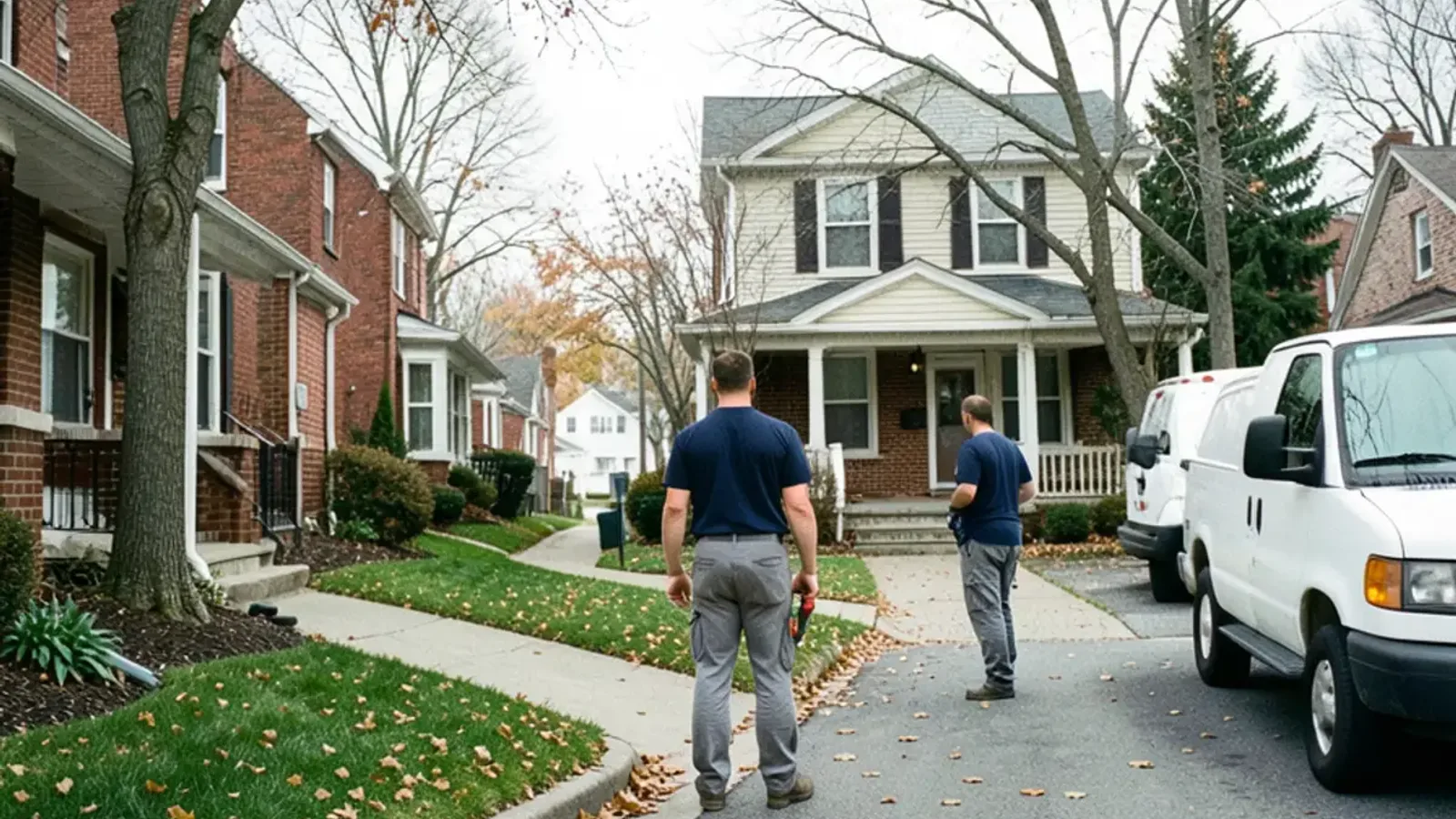
Center Line plumbing calls come from a city of 1.75 square miles that Warren wraps around on every side. Stephens Road, the street our office is on, runs along its south edge, so this is the shortest trip we make outside Warren. What makes the work here different is the mix. About half of Center Line’s homes went up before 1960, and almost half of its households rent, a good share of them in apartment buildings of 50 units or more. So a week here can mean a 1940s bungalow with rusted galvanized pipe on Monday and a shared drain stack serving a whole floor of tenants on Tuesday. Center Line also runs its own water and sewer system, separate from Warren’s.
Van Dyke apartments and 1950s brick houses on the same blocks
Census figures put the median Center Line home at 1960. One in four was built in the 1950s, and another quarter is older than that, some of it from before Center Line became a city in 1936. Fifty-eight percent of homes are detached houses. The rest are mostly apartments, including 480 units in buildings with 50 or more.
From the trade side, a house from the 1940s or 1950s tends to have a cast iron stack, a cast iron or clay building drain under the basement slab, and a clay tile lateral out to the city sewer. Supply pipe in the oldest houses is often galvanized steel, which rusts shut from the inside; copper became the norm later in the 1950s. Apartment buildings bring their own problems. One partly blocked stack backs up into the lowest unit, and one failing tank heater leaves a whole wing with cold showers.
Rain follows its own route. An October 2026 city storm water notice says most street runoff drops into catch basins and on into underground drains that Macomb County maintains. Your floor drain empties another way, through your own lateral, where a root-packed clay joint backs up first.
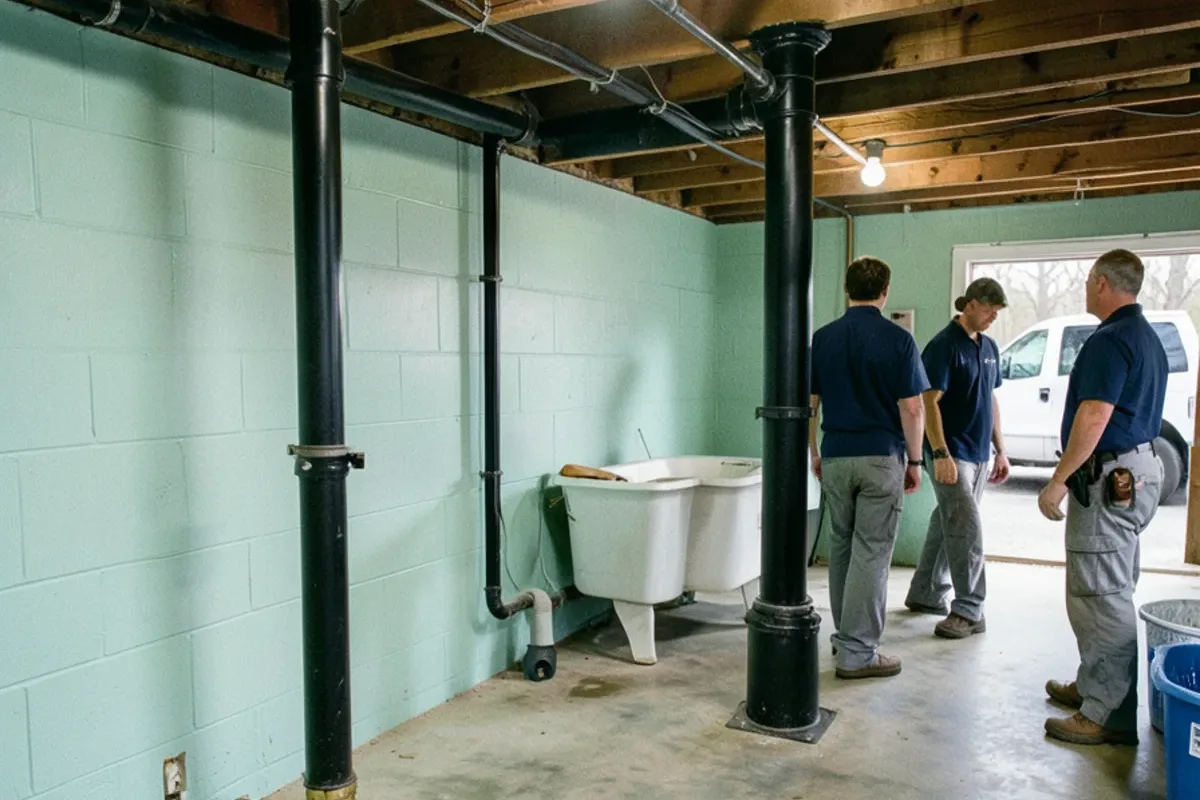
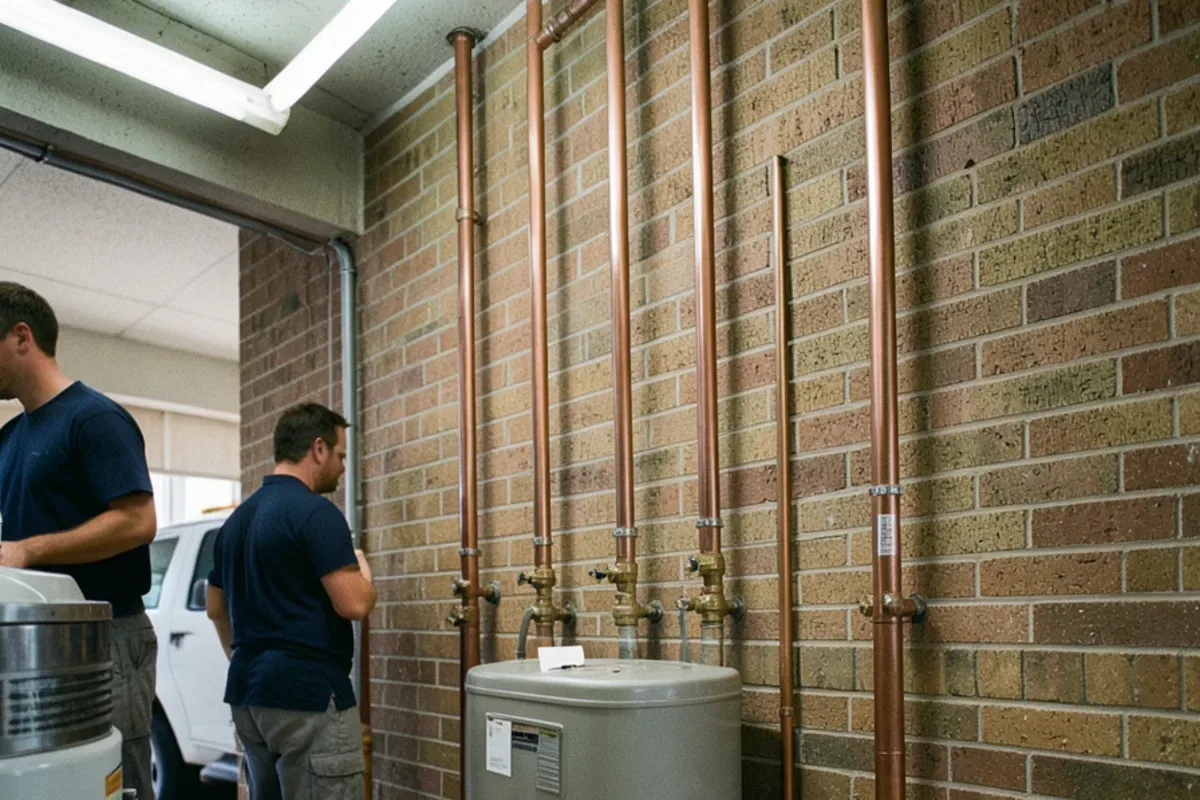
Plumbing calls that fit Center Line’s 1950s houses and Van Dyke rentals
- Basement floor drain cleaning
Pre-1960 basements drain through old clay laterals, and the city’s side of the sewer stops at the property line, so a slow floor drain is usually the owner’s line to clear.
- Galvanized pipe replacement
About a quarter of the city’s homes date from the 1940s or earlier, the era when galvanized supply pipe was standard, and rust narrowing it from the inside is why taps lose pressure one at a time.
- Main water line repair
The city is checking the material of every water service line, and an old line found during that check often needs work at the meter or foundation.
- Backflow prevention and testing
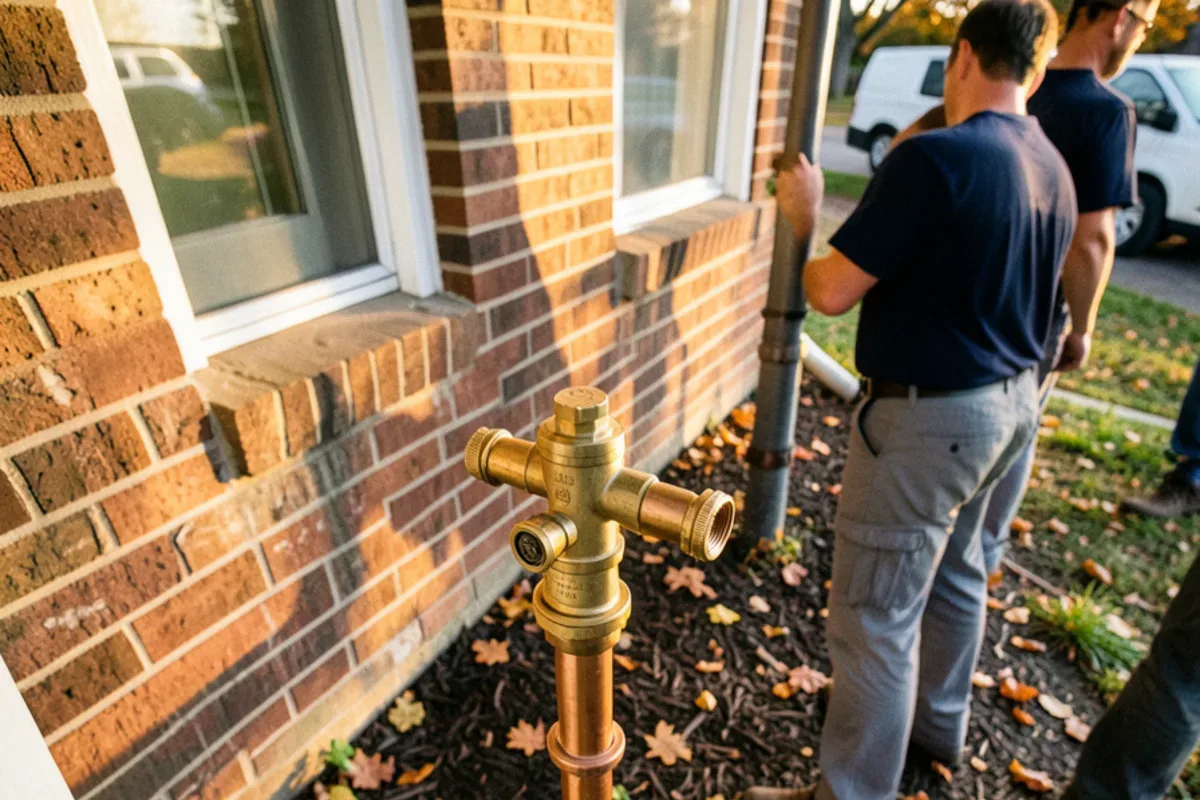
Center Line’s DPW runs a residential cross-connection program, and the city wants a plumbing permit before a backflow preventer is installed or replaced, such as the common one on a lawn sprinkler line.
- Plumbing for landlords and property managers
Nearly half of Center Line households rent, and the large buildings off Van Dyke share stacks, mains and water heaters across many units, so a repair has to be planned around every tenant on that line.
- Water heater installation
In a 1950s Center Line basement the tank heater usually shares a cramped corner with the stack and floor drain, and in the 50-plus-unit buildings off Van Dyke one failed heater can leave a wing without hot water.
- Emergency plumbing repairs
Nearly half of Center Line households rent, many in apartment buildings off Van Dyke, so one split line or backed-up stack can reach several units and the first job is finding the building shutoff.
Up Hoover Road and across 10 Mile to a Center Line call
Our office sits on Stephens Rd just west of Hoover. To reach Center Line we take Hoover Road north to 10 Mile and head west toward Van Dyke and the city offices. The city runs from Stephens up to 11 Mile and I-696, on both sides of Van Dyke. Because the trip is short, a Center Line call can often be fitted between other jobs on our side of Warren. We tell you on the phone where your visit falls in the day.
In a single-family house, we start at the water meter and the main shutoff, because that is where the service line comes through the foundation and where its material is easiest to see. Then the floor drain, the cleanout on the stack and the water heater venting. In an apartment building we ask for the utility room first and find out which shutoffs serve which units before any pipe is opened.
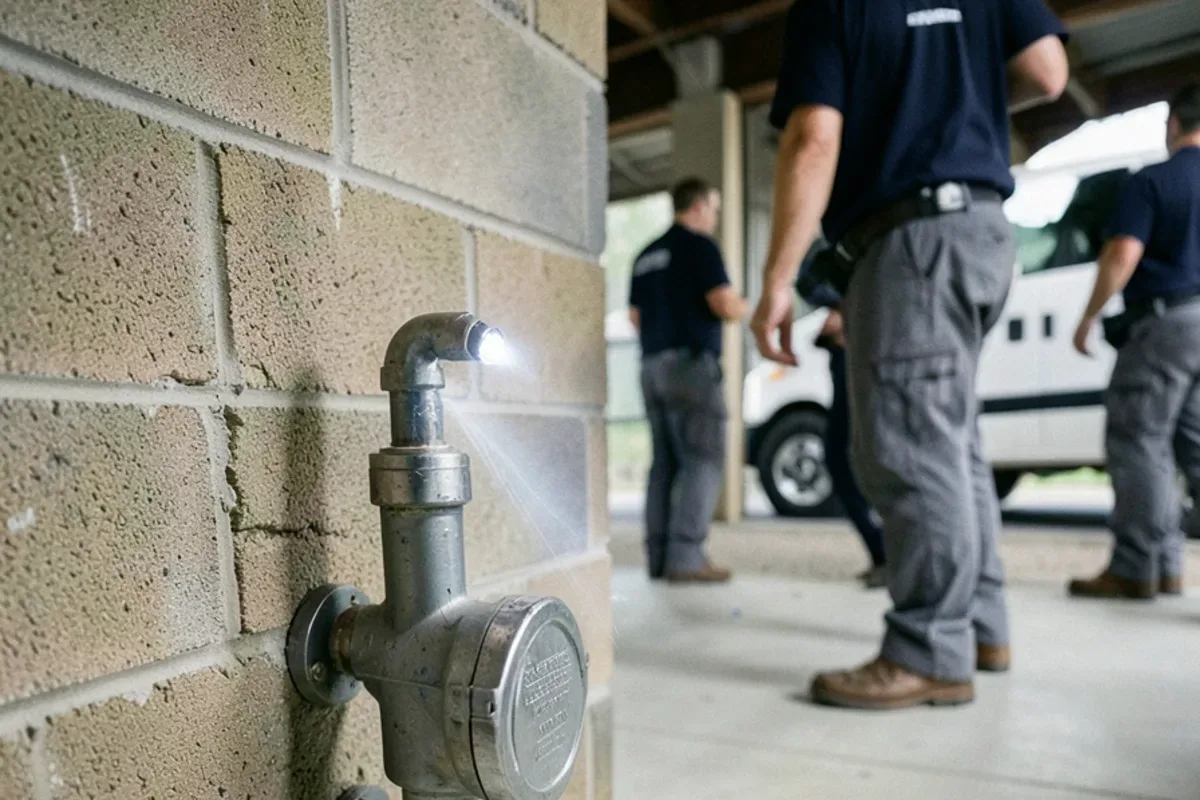
Permits at 7070 E. 10 Mile Road and the sewer behind them
Center Line issues its own plumbing permits through the Building Department at city offices on 10 Mile. Its application asks every contractor to register with the city. A homeowner can apply too, but only for work they do themselves, and they have to arrange the inspections. New single-family work gets underground, rough and final inspections, and a remodel needs at least a rough and a final.
The public sewer has its own history. Center Line’s outfall, a 24-inch concrete line built in 1962, runs about a mile and a half to the Detroit system. In 2009 the city lined it and turned it into a pressure line, and a temporary tie-in to a Warren interceptor built during that project was kept for good. In 2025 the city received state funding to improve its pump station and send more flow to the regional system. None of that changes your part: the city’s sewer backup form says city service ends at the property line. Our post on who owns the sewer line explains what that means for your lateral, and sewer camera inspection is how we find out what is inside it.
Places between Stephens and 11 Mile we pass on the way
- Memorial Park, behind the Parks and Recreation building on Lawrence Street, where the city holds its Independence Day festival.
- Memorial Field, next door, where the Center Line Public Library runs outdoor programs.
- City offices and the Building Department at 7070 E. 10 Mile Road.
- The St. Clement historical markers, near where the parish built its first wooden church along Van Dyke in 1854.
- Center Line High School, part of Center Line Public Schools, which serves most of the city.
- The row of small restaurants and shops on Van Dyke between 10 Mile and Stephens.
The restaurants on that strip send grease into commercial drains every day, which is a different job from a house; our restaurant plumbing page covers grease lines and interceptors. Larger public buildings usually carry testable backflow assemblies that a certified tester checks each year, a bigger version of the devices the DPW tracks at homes.
Getting to our office from Center Line
From Center Line, take 10 Mile Road east to Hoover Road, then turn south on Hoover to Stephens Rd; our office is about 0.2 miles west of Hoover.
11355 Stephens Rd, Warren, MI 48089
Get directions to our Warren officeCenter Line plumbing questions
Is Center Line water and sewer run by Warren?
No. Center Line has its own Department of Public Works, which buys water and sewage treatment from the Great Lakes Water Authority and runs the pipes inside the city. Billing, service line questions and sewer complaints go to Center Line, not to Warren.
How do I find out what my water service line is made of?
The city is required to verify the material of every service line, either through a DPW inspection or photos sent in by the homeowner. Look where the pipe enters the basement next to the meter. For health questions about lead, the city DPW and the state environmental agency, EGLE, are the right places to ask. If the line needs repair on your side, we can look at it.
Who fixes it when sewage comes up my basement floor drain?
Call the city DPW first so they can check whether the main in the street is blocked. Center Line’s sewer backup form notes that city service ends at the property line. If the main is running fine, the problem is usually in your own building drain or lateral, and that is where we come in with a cable and a camera.
Have a plumbing problem in Center Line? Tell us the address and what's happening.
(207) 419-2600Near Center Line
- Plumber in Madison HeightsAcross Dequindre in Oakland County, where the Kuhn basin sits at I-75 and 12 Mile
- Plumber in Hazel ParkPostwar Cape Cods and bungalows between 8 Mile and 10 Mile on the Oakland side
- Plumber in Sterling HeightsWarren’s neighbor to the north, across 14 Mile Road
- Plumber in RosevilleWarren’s eastern neighbor in south Macomb County
- Macomb CountyThe county Center Line shares with Warren and the suburbs east and north
See every city we serve around Warren · More Macomb County cities · Who owns the sewer line between your house and the street · Plumbing checklist for landlords between tenants
Last updated October 25, 2026